



In 2026, the vast majority of media buying teams utilize neural networks in one way or another. Media buyers build automated systems for generating creatives and pre-landing pages, as well as compiling reports. Some even attempt to build intelligent management systems powered by AI.
However, there is a distinct lack of honest breakdowns regarding the actual results of integrating AI into daily workflows online. Let us explore whether affiliate marketers can genuinely offload tasks to neural networks or if optimizing workflows with AI turns out to be a massive failure. Find out what actually works for teams that decided to automate their CRM and other tools using neural networks.
From auto-launching to creatives: what teams hand over to automation
One of the most common myths over the last couple of years is that neural networks will soon take over the majority of a media buyer’s workload. In reality, case studies in the affiliate space are not so black and white.
Cloud-based CRMs, trackers, and spreadsheets are convenient as long as the buying team is small. As the number of buyers, traffic sources, daily caps, and ad combinations grows, the team must react much faster. Manual management starts to fail, and automating routine tasks becomes complicated.
Typical expectations from teams include:
- Data from various ad accounts and trackers is collected in a single location and analyzed;
- The system automatically handles routine processes (budget allocation, generation, and adaptation of ad materials);
- Hypotheses can be tested rapidly.
The desire to build a proprietary CRM and automate processes via AI is completely justified. A neural network can create a working prototype if given a clear and detailed prompt. However, it takes a massive amount of time to refine that prototype into a perfect product. The system must be adapted to real-world processes, potential bugs, and inconsistencies. Roughly 80% of artificial intelligence projects fail to transition from the prototype phase to full production.
It is much easier and smarter to gradually optimize processes through neural networks where:
- There are many repetitive actions;
- Data is already structured but requires processing;
- The result can be easily evaluated, and the criteria are clear;
- Errors can be detected before the budget is drained.
The final decision still rests with a human. In most successful cases of integrating AI into CRM and other specialist workflows, the human is not completely replaced.
Where AI really helped: top 5 illustrative cases
Let us look at examples where proprietary automation paired with neural networks proved genuinely useful.
Case 1. Proprietary auto-launch system with AI
Ivan’s team independently built an internal ad management tool powered by AI—an auto-launch system called LeadTrack. The CRM for Facebook ad analytics was initially created for their own internal needs. The service integrates directly with the Meta API.
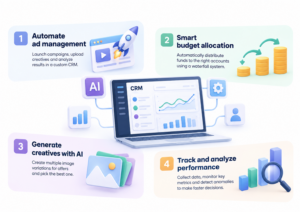
Using this custom product, the team automated several routine advertising processes. Thanks to the CRM, they can automatically:
- Launch campaigns, including uploading video assets;
- Save their winning ad combinations;
- Create pixels;
- Analyze account data;
- Upload templates.
The auto-launch system operates via a System User and Facebook tokens. The service is still in beta testing but is already delivering solid results. According to the buyers, everything works flawlessly.
The only issue is that developer accounts get banned, forcing them to reconnect everything from scratch. This is a systemic problem. Platform developers often ban accounts partly due to API restriction circumvention. There is no protection against this type of block, meaning the team has to spend time and nerves getting unbanned.
Case 2. Waterfall budgets
The next case also comes from Ivan’s team. The guys were tired of wasting time manually redistributing budgets among buyers. They decided to build an automated solution for top-ups.
“After we automated the top-ups, the budget is distributed among the buyers’ accounts on a ‘waterfall’ principle, taking current balances into account. Now, there is no need to waste time on manual top-ups and checking the balances of dozens of accounts,” says Ivan, owner of This is Fine Agency, with over 7 years of experience in traffic arbitrage.
The team has several buyers, each with their own ad accounts. Some accounts have plenty of budget, while others are running on fumes. Manually topping up accounts and monitoring balances is highly inconvenient. Therefore, they decided to automate campaign funding using a waterfall method.
From the central budget, funds first go to accounts with the lowest balances, then to high-spending accounts, and finally to the rest. This automation reduces delays and operational errors during transactions.
Case 3. Automating image creation
In another project involving agency accounts, Ivan’s team automated the creation of images for posts. The neural network performed exceptionally well. The buyer writes the post, and the AI generates five different images that match the context of the text. The buyer simply has to pick the best one.
“Without a long-term memory system for AI agents, any automation will just remain a set of disjointed scripts that work until the first glitch. Use Harness Engineering and a memory system. I recommend Hindsight, which can be deployed via Docker. Your agents will then work autonomously for hours and deliver final results,” notes Ivan, owner of This is Fine Agency.
Case 4. AI as a surface layer in CRM
GetDevDone upgraded a client’s CRM by integrating AI only after the core processes had already been systematized and structured. The team joined the project midway. Previous developers had prepared the CRM database but failed to scale it.
GetDevDone reworked the system’s architecture, integrated a partner search feature, and added GPT-powered reporting. The Smart Reports feature enabled the team to receive analytical summaries of campaigns, performance forecasts, and content suggestions.
A neural network cannot replace a data infrastructure. If the database and unified data formats are not properly developed, the model must be constantly retrained and fed different sources. Because of this, the cost and complexity of the system skyrocket.
Case 5. Analytics
Neural networks can be trusted with data collection, analysis, and metric monitoring.
For example, one affiliate team connected an AI system to their tracker via API. The neural network calculates expenses, revenues, CPL, CR, and ROI, while also identifying anomalies. The buyer receives the calculated data in a Telegram bot, interprets it independently, and makes decisions. In other words, the AI signals the results but does not take control of the ad campaigns.
In this case, the neural network saved the team several hours of manually reviewing and analyzing statistics.
Where AI leads to extra work in automation
Sometimes, a neural network underperforms or executes tasks in a technically flawed manner.
Creative factory, but with complications
Ivan’s team decided to automate creative production. The concept was that a buyer uploads creatives they like, the neural network analyzes them, and generates similar variations adapted for a specific offer.
“The content factory turned out to be much more complex than it seems. A text-based LLM needs to be explained what is depicted in the video. It cannot ‘see’ anything unless the information is passed to it in the correct format.
This is where advanced multimodal models really shine. You give it a task, and it searches for possible solutions on its own. All you have to do is test. You act as the manager, checking the results and saying ‘this is good’ or ‘fix this part’,” explains Ivan, owner of This is Fine Agency.
AI drains budgets
An analytical industry report highlights how AI in automation can actually increase the number of errors and drain budgets. Critical AI mistakes include:
- Stripping tracking parameters: Replacing an affiliate link with a clean one, removing the aff_id, subid, or tracking parameters. The page looks correct, but no commission will be tracked. Some reports claim teams lose up to 22% of planned revenue due to this.
- Incorrect links after publishing: The link is correct inside the CRM, but after clicking, the platform “cuts off” the URL tails containing subids and other tags.
- Routing to dead pages: The AI considers links active even if they lead to a “404” or an “out of stock” page.
- Geo-mismatches: The neural network displays links for any geo, even if the offer is restricted to a single country.
- Ignoring corrections: The buyer replaces a link, but the neural network follows the old template and directs the user to the outdated URL.
- Incorrect data cleaning: Duplicate records in the CRM compound errors with every step, ruining report accuracy.
In this scenario, automation via neural networks turns a minor mistake into a systemic commission leak.
Conclusion
Proprietary automated systems powered by AI in traffic arbitrage pay off if they handle familiar routine tasks under human supervision. Neural networks assist with auto-launching, budget distribution, and generating static creatives. However, the idea of a CRM or AI automation fails if the team expects the neural network to understand deep context, work flawlessly with video, or exhibit human-like flexibility.