


For many media buying teams, 2026 feels as though major advertising platforms have simultaneously decided to test the market’s resilience.
Between ongoing turbulence in Meta, widespread bans on farmed accounts in Google Ads, instant suspensions, repeated reviews of active campaigns, and sweeping cleanups across Bing and Taboola, the digital landscape is shifting rapidly.
Individually, none of these processes are entirely unprecedented: account suspensions have always been a reality, and iGaming regulations are frequently updated. However, when multiple restrictive measures converge within a single quarter, it raises a legitimate question: is this merely another seasonal fluctuation, or are advertising platforms genuinely entering a much stricter operational era?
Let us analyze, alongside our technical specialists, what has truly changed in the market, why high-risk verticals like iGaming are bearing the brunt of this pressure, and what actionable steps teams can take right now.
Third quarter of 2026: What teams are experiencing in practice
If we examine the current challenges faced by media buyers, a rather concerning picture emerges. Meta is enduring its most significant turbulence in recent times, Google is accelerating account suspensions and re-verifying active campaigns, and platforms like Bing are increasingly flagging accounts for moderation issues and restrictions.
The situation within Meta
The current wave of suspensions is among the most aggressive seen in the past three to five years, drawing parallels to the severe crackdowns of 2022. The market is once again facing an unprecedented density of bans.
Accounts linked to standard payment cards are taking the hardest hit. In certain scenarios, the ban rate for these accounts has skyrocketed to 80–90%, drastically reducing the pool of accounts that can successfully launch and maintain stable operations.
Conversely, accounts utilizing credit lines currently appear more stable, but they are simultaneously becoming more expensive. The market is rapidly adapting to this shifted demand, driving up the cost of such infrastructure.
A distinct challenge over recent weeks involves the transfer of pixels between Business Managers. In numerous instances, pixels fail to transfer correctly to other BMs, disrupting established launch frameworks and forcing teams to rebuild their infrastructure mid-campaign.
The situation within Google
In the Google ecosystem, the primary impact has been felt by farmed accounts and mass-scale infrastructure. Throughout August and September, teams frequently encountered scenarios where batches of accounts were suspended en masse, necessitating appeals that were not always successful.
Concurrently, requests for additional verification have surged. Active accounts are increasingly subjected to Business Operations Verification (BOV) and other stringent checks, while some new launches are halted before they even begin to generate meaningful traffic.
Accounts registered in bulk are suffering the most. Those created in large batches, utilizing identical or recycled proxies, phone numbers, and templated infrastructure, are being flagged due to these highly recognizable, repetitive signals.
The situation across other platforms
The dynamics in Bing and Taboola differ slightly, but the overarching trend remains consistent: moderation is tightening, and platforms are scrutinizing not just the advertisements, but the entire underlying infrastructure.
For gambling and other regulated verticals on Bing, valid licenses and accurate advertiser data remain paramount. Additional checks are frequently triggered by minor changes to account or business information, making successful launches heavily dependent on how cleanly and consistently the infrastructure is assembled.
On Taboola, the primary issue is less about mass suspensions and more about heightened standards for creatives, domains, and overall advertiser quality. Certain assets are flagged for secondary review, specific accounts face restrictions, and weak domains or repetitive patterns are swiftly identified as liabilities.
Why high-risk verticals are taking the hardest hit
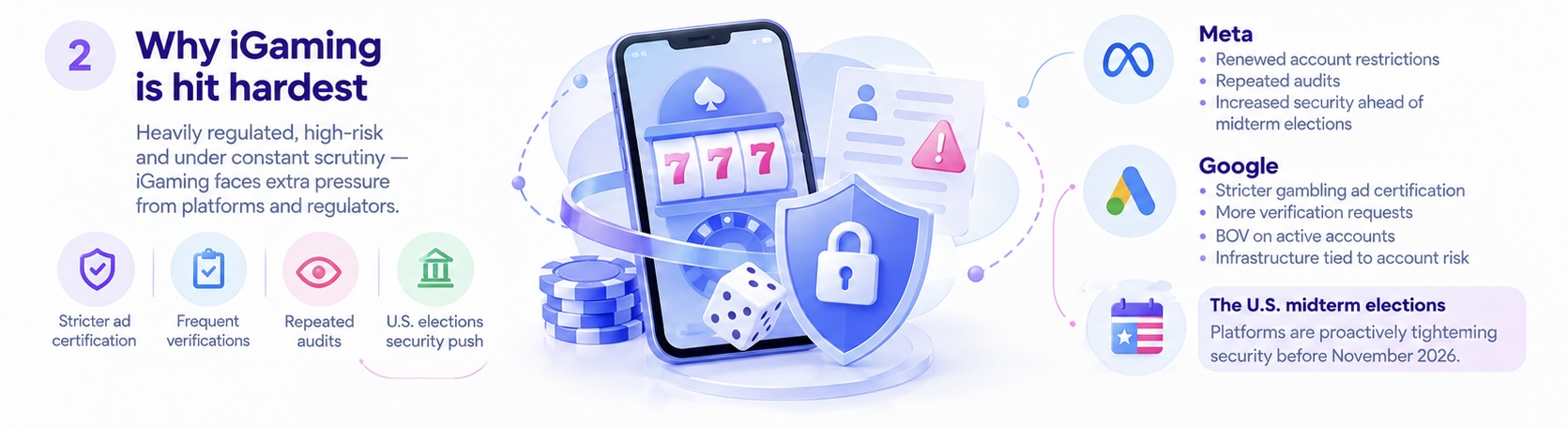
The iGaming sector faces an additional layer of complexity. Amidst broader market instability, platforms are continuously tightening their policies regarding gambling advertisements and other heavily regulated categories.
In Meta, this manifests through renewed waves of account restrictions, repeated audits, and general instability within advertising cabinets. Furthermore, the platform is simultaneously ramping up its security measures ahead of the upcoming U.S. midterm elections. Consequently, any new wave of restrictions in the third quarter is felt particularly acutely by the market. While there may not be a direct causal link between the current turbulence and the elections, the overall level of platform scrutiny is undeniably elevated.
In Google, the pressure is multifaceted. Beyond stricter gambling ad certification processes, teams are encountering more frequent verification requests. BOV prompts can appear on already active accounts, and repeated audits are increasingly becoming a standard, albeit frustrating, part of the launch process.
This is especially critical for iGaming, as a single additional verification can halt a fully prepared campaign. Furthermore, issues at the account level are no longer just about the creative assets; they are deeply tied to the underlying infrastructure: domains, corporate data, the managing account, and the historical footprint of linked cabinets.
The connection to the U.S. midterm elections
This is one of the most plausible explanations for the current landscape.
With the U.S. midterm elections scheduled for November 2026, major platforms are proactively tightening their security protocols. Meta announced its election preparedness, enhanced security measures, and restrictions on political advertising as early as February. Similarly, Google issued statements in September regarding reinforced protections against service abuse during the pre-election period.
Actionable steps for media buyers right now
Panic and complete work stoppage are not the answers. However, operating under the assumption that the market functions exactly as it did six months ago is now a significant risk.
Do not concentrate your entire volume on a single bundle A single ban or repeated audit should not bring your entire spend to a halt. It is crucial to maintain a reserve of key elements: backup domains, alternative landing pages, diversified funnels, and multiple traffic sources. The goal is not to build an endlessly complex infrastructure, but to ensure that a disruption does not force you to start entirely from scratch.
Strategies for navigating Facebook Given the current turbulence, the most logical approach includes:
- Thoroughly warming up accounts before launching campaigns.
- Minimizing unnecessary actions within the Business Manager.
- Utilizing high-quality, reputable resources and assets.
- Avoiding the simultaneous scaling of a large number of accounts.
- Increasing spend volumes gradually and methodically.
- Leaving stable, performing setups untouched.
Strategies for navigating Google In this environment, it is vital to calculate not just the cost of an account, but the cost of downtime. Losing an active, high-performing account is not merely an expense of purchasing a replacement. It
means halted campaigns, retraining algorithms, enduring additional verifications, facing certification risks, and losing valuable time to restore momentum.
Therefore, for large-scale operations, it makes sense to transition away from disposable, mass-produced infrastructure toward more resilient setups:
• Utilize accounts with an established history of legitimate spend.
• Build a stable, unique infrastructure for each account.
• Avoid mass-repeated proxies, phone numbers, templated websites, and identical behavioral patterns.
• Proactively prepare all necessary data and documentation for potential verification requests.
• Design your launch strategy so that a single problematic signal does not link and compromise dozens of accounts simultaneously.
Keep alternative traffic sources active and tested If your entire operation relies solely on Meta or Google, any platform-wide turbulence immediately becomes a critical business threat. Consequently, new traffic sources should be tested and integrated proactively, well before your primary source experiences a disruption.