



Can creative work be transformed from a process reliant purely on inspiration into a systematic, repeatable workflow? How does one build a year-long PR plan, source fresh ideas, and tackle current business challenges? During a recent expert panel, three industry professionals—a CMO of a major affiliate network, a CMO of an agency network, and a Head of PR—discussed these exact questions. The experts broke down the most common pitfalls, shared personal experiences, and offered actionable advice on avoiding creative chaos by building a robust system.
Why it is crucial to constantly seek inspiration and ideas
One of the first points the experts highlighted was the importance of finding creative inspiration outside of immediate business tasks. Ideas should emerge and accumulate long before a specific project requires them. These can be individual references, case studies, or successful campaigns from other brands that the team discusses during dedicated meetings.
One of the speakers emphasized this continuous approach. According to her, the team holds general brainstorming sessions several times a month, where solutions often emerge from healthy debate and the exchange of diverse opinions.
“The key here is consistency. You must regularly save brilliant ideas and unique features so they can be discussed later. Often, it is not the task that gives birth to the idea, but rather the other way around,” she noted.
For another expert, the environment in which the team operates is just as important as regularity. If team members believe that every raw thought will be immediately judged or criticized, they are more likely to present safe, conventional options rather than truly innovative concepts.
Therefore, during the initial phase, ideas do not need to be entirely realistic. They can be filtered out later, once the team has gathered a substantial pool of material to evaluate.
“The most important rule is that team members must feel comfortable bringing even the most absurd or wild ideas to the table. We listen to everything. The brainstorming process goes through several rounds before we finally settle on a polished concept,” she explained.
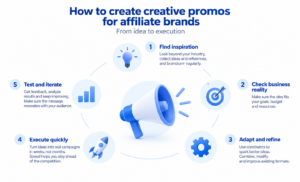
To summarize, here are the key recommendations for marketing and PR teams:
- Build an idea repository. Discuss and accumulate concepts, hold brainstorming sessions without a specific agenda, and save your findings. Refer back to this strategic reserve whenever a new need arises.
- Be cautious with criticism. Creativity thrives on freedom of thought. Make sure your team understands this. Even a seemingly unworkable idea can evolve into a highly effective promo for a major project.
- Do not be afraid to experiment, but always keep the project’s constraints, budget, and your team’s capabilities in mind.
A strong idea must pass a business reality check
After the brainstorming phase comes a less visible but equally critical step: verifying the idea against the core business objective, budget, and execution capabilities.
In affiliate marketing, it is remarkably easy to invent a mechanic that looks flawless on a presentation slide but becomes overwhelmingly complex during actual deployment. Therefore, constraints should be considered during the idea’s development, not after it has been selected.
For one of the experts, the process follows a clear sequence: objective → discussion → brainstorming → concept selection → refinement → preparation for execution → testing → result analysis. The number of initial ideas will always vastly outnumber the projects that ultimately reach the audience.
Furthermore, a large budget does not automatically guarantee high quality. Sometimes, a complex and expensive concept is outperformed by a simple mechanic that is easy to explain and execute quickly.
“Frequently, an idea is genuinely brilliant but far too costly. However, it also happens that a top-tier idea costs, as my management puts it, ‘the price of three beers.’ And those low-cost ideas often perform better than something with a hundred-million-dollar budget,” she emphasized.
For the agency CMO, the business objective remains the starting point—for instance, the need to promote a product, draw attention to a campaign, or incentivize partners. Only after defining this does the team search for a mechanic and verify its realism and brand alignment.
However, the reverse scenario is also possible: sometimes a powerful idea emerges before any specific task exists. In such cases, the business can adapt to the idea if the team identifies a clear path to achieving results.
This is the crucial distinction between a mere amusing concept and true creativity. Ultimately, a promo must not only capture attention but also solve a specific business problem. In our industry, this fundamental principle is often lost during the promo creation process.
Originality does not always equal effectiveness
The desire to invent something that has never been done before is commendable. In practice, however, this is a very high bar, especially in an industry where companies constantly observe one another and everyone knows everyone else’s moves.
Consequently, a significant portion of effective creativity is built upon familiar mechanics. The key is not to copy a ready-made solution, but to understand its underlying principle and adapt it to your specific audience and objective.
The PR expert acknowledged that absolute novelty remains more of a distant dream than a standard for every project.
“So much has already been done and invented. Most of the time, we are just reinventing the wheel. We present the client with several options: some are things that have existed elsewhere, some are a ‘Frankenstein’ combination of different ideas, and the remaining part is what we consider truly original,” he explained.
For the agency CMO, there is no need to choose only one approach. An existing format can often prove much more effective than a desperate attempt to invent something entirely new.
“Novelty does not guarantee effectiveness. Any format that has been used before can be adapted and applied to your own brand to make it work even better,” she reasoned.
A great example is a Formula 1 promo campaign. The team proposed a mechanic where participants who reached a specific traffic volume received a race ticket, a business-class flight, and a stay at a five-star hotel.
The idea was a success, but later, a different product implemented a similar mechanic and achieved an even larger reach. This does not make the original case a failure; rather, it highlights the vast difference between being the first to think of it and executing it more noticeably.
Your visual library should not be limited to your own market
Monitoring competitors is useful, but constantly looking only at them means gradually narrowing your own worldview. Within a single industry, the same mechanics quickly begin to repeat. Moreover, people become accustomed to perceiving certain solutions as the only possible ones simply because they have seen them multiple times from others.
One expert noted that she felt this particularly strongly after immersing herself in the affiliate sphere. When she first entered the industry, she had far more ideas precisely because she had not yet internalized the internal limitations and conventional formats.
“When I first started, I had many more interesting, unusual, and fresh ideas for the sphere. Perhaps they would not have worked, or perhaps they would not have fit our target audience at all, but nevertheless, there were more of them,” she recalled.
Therefore, it is worth seeking references outside of affiliate marketing. B2C, fashion, mass advertising, entertainment, cinema, and other markets engage
audience attention differently—which means they can provide mechanics that have not yet become cliché in B2B.
At the same time, completely disconnecting from your own market is not advisable. One expert suggests separating monitoring from referencing: know what your competitors are doing, but do not let their solutions dictate your own thinking.
“If you completely stop observing and watching the market, you exist in a vacuum. You still need to understand what others are doing and draw inspiration from it. You must separate monitoring from referencing,” she noted.
The PR expert looks even broader, suggesting that ideas should be sought in culture: from advertising and music to major film premieres. This approach allows you to collect underlying principles rather than ready-made solutions, which can then be adapted to your specific task.
Constraints actually help you think faster
Paradoxically, the absence of limitations does not always make creativity easier. When a team is tasked with coming up with “something cool,” the sheer number of options makes choosing just one significantly harder.
Therefore, when an idea is not forthcoming, it is useful to first narrow the search field. Break down a familiar format into its core elements and start changing them one by one: the text, the visuals, the video, the mechanic, or the delivery method.
The PR expert advocates for this exact technical approach. Instead of trying to generate a complete concept from scratch, the team takes an existing format and asks: what happens if we replace its components?
“You can step away from just trying to ‘generate’ ideas. You can sit, think, look at things, and sketch out technical solutions point by point. For example, we have a basic seeding campaign. What does it consist of? Text, an image, a video, or a GIF. Fine, we cross all of that out and choose a completely different format,” he stated.
Another expert suggests a similar principle, but starting even earlier. You do not necessarily need to see the final concept immediately; it is enough to latch onto a single word, association, or question and begin expanding upon it.
In this sense, even tools like AI can be useful as a starting point, but not as a replacement for your own visual library and expertise. The goal is to kickstart the thinking process, not to obtain a finished idea with a single prompt.
Another method is to turn limitations into task parameters. No budget for a video shoot? Then look for a format that does not require one. No resources for complex development? Remove non-essential elements. Short on time? Then the idea must be executable quickly.
Once constraints are clearly formulated, the blank page disappears, replaced by a concrete problem that can be solved.
Speed becomes an integral part of creativity
In a rapidly changing industry, having a good idea is not enough. You must execute it before someone else comes up with a similar solution. Therefore, long-term planning and planning specific creative campaigns are not the same thing. You can build a strategy for a quarter or a year, but a specific mechanic might need to be revised in a matter of weeks.
One expert has ideas that have remained in her notes for years. However, when it comes to a specific campaign, she tries not to stretch the path to execution.
“Nowadays, I no longer make year-long plans. I might outline some global strategies, but definitely not for specific creatives. Most of the time, the journey from idea to execution of a creative campaign takes a week to a month, no more. I understand that if I come up with something at the beginning of the year, someone else will 100% do the exact same thing by September,” she shared.
Another expert shared a story that illustrates this problem even more clearly. After the company gifted her a skydiving experience in Dubai, she conceived an entire PR mechanic: find a media personality willing to jump with her, shoot several videos, turn the search for a partner into a separate news hook, and seamlessly integrate the brand into the story.
The idea emerged completely organically, but during preparation, it was discovered that a competitor had already implemented a similar format.
“One good, brilliant idea never comes to just one person, especially in our field; it comes to ten people at once. Therefore, speed is incredibly important, especially in PR,” she emphasized.
The point here is not to abandon planning altogether. On the contrary, a pre-formulated news hook gives the team time to think. However, the closer the launch gets, the more crucial the ability to adapt quickly becomes, even if it means abandoning an idea that seemed perfect just days ago.
Creativity must be tested
There is one more reason an idea might fail: the team has looked at it from the inside for too long. When several people brainstorm a promo together, they understand the entire context. They get the joke, the reference, and the meaning behind every element. The audience, however, only receives the final version, and they do not always dive into it with the same level of dedication. Therefore, external evaluation becomes a separate, essential part of the creative process.
The PR expert draws attention precisely to this gap between the creator and the viewer:
“A person will look at this implemented idea for maybe three seconds. They are unlikely to fill in the blanks or figure out what you were trying to say.”
For an affiliate brand, a particularly useful test is the reaction of someone who works directly with the target audience. For example, an account manager who communicates with partners every single day. If they struggle to quickly explain the essence of the promo and why a partner should participate, that is far more important than the team’s internal belief that the idea is destined for success.
Creativity should make your brand stand out, but it should never force the audience to waste time deciphering the core message.